Saturday, February 20, 2010

Week in Microsoft: Windows Phone 7 Series arrives

Windows Phone 7 Series arrives:


This week at Mobile World Congress, Microsoft showed off its new phone platform for the first time. Everything that we knew and loathed about Windows Mobile is gone. Even the name is different. It's now 'Windows Phone 7 Series.'

One of the many unanswered questions about Windows Phone 7 Series is what the application development situation will be like. A few details have started to emerge; through both official and unofficial channels and the big news is that application development will use managed code more or less exclusively.


Read the rest of this article...

Tuesday, February 9, 2010

New Google Buzz vs. Twitter and Facebook

Google strikes again!!

The folks at Google just rolled out yet another application that tackles an area previously dominated by Twitter and Facebook: Microblogging! Microblogging is posting small entries that usually consist of nothing but a short sentence fragment, or an image or embedded video. This is commonly known as "tweeting" for those who use Twitter (except that Twitter only allows text and URLs - no images or videos). The same concept is found in Facebook where users post status updates, images, videos and links.

Enter Google Buzz: a microblogging system on top of Gmail that enables users of posting text, photos, videos, etc., and share with either their friends or everyone. Watch this video to get the idea:


Google Buzz is being enabled into the existing Gmail accounts slowly, so it's not yet available for all users. I haven't tried it out myself yet, but I can't wait to start "buzzing"

Saturday, February 6, 2010

Windows 7 growing faster than Vista, overtakes Mac OS X

Windows 7 growing faster than Vista, overtakes Mac OS X

Windows 7 sold well during the 2009 holiday season, and the results are showing up, not only in sheer revenue, but in the OS market share numbers as well. Nevertheless, in December 2009, Linux was the only operating system to show positive percentage growth in market share.

Between November and December 2009, Windows market share dropped 0.31 percentage points (from 92.52 percent to 92.21 percent), Mac OS dipped 0.01 percentage points (from 5.12 percent to 5.11 percent), and Linux edged forward 0.02 percentage points (from 1.00 percent to 1.02 percent).

Strong sales from Windows 7 and Snow Leopard were not enough to stop both Windows overall and Mac OS overall from dropping. When putting this into perspective across the whole year, though, we see that Windows was actually sliding steadily throughout 2009 (93.66 percent in January 2009), while both Mac OS (4.71 percent in January 2009) and Linux (0.90 percent in January 2009) have been gaining.


You can see the market share pie for December 2009, according to Net Applications, at the top of this post. The graph directly above this paragraph shows how things at Ars are different from those elsewhere, but the differences aren't as significant when it comes to the browser market: our Mac OS share is more than five times greater than the rest of the world, while Linux is six times more. Nevertheless, more than half of our users are on Windows.


Even if Windows is slowly losing share, Windows 7 is doing phenomenally well. Above, you can see how quickly the OS has been gaining share in its first few months compared to Windows Vista's first few months.

While Vista was at 0.93 percent after a month, Windows 7 was at 4.00 percent; when Vista jumped to 2.04 percent after two months, Windows 7 hit 5.71 percent.

There are many reasons for this, including the fact that Vista had to compete with XP, which was on the market for an abnormally long time. Furthermore, Windows 7 arrived in time for holiday sales, while Vista did not. In addition, Windows 7 had a very successful beta program, both private and public. Most importantly though, Microsoft managed to generate the kind of hype around Windows 7 that it hasn't generated around any of its operating systems in years.


In terms of OS versions, Windows saw the following changes between November and December: Windows XP dropped 1.28 percentage points (from 69.05 percent to 67.77 percent), Windows Vista dropped 0.68 percentage points (from 18.55 percent to 17.87 percent), and Windows 7 gained 1.71 percentage points (from 4.00 percent to 5.71 percent), meaning it has passed all versions of Mac OS. Speaking of which, Mac OS saw the following progress: version 10.4 dipped 0.04 percentage points (from 0.84 percent to 0.80 percent), version 10.5 dipped 0.14 percentage points (from 2.61 percent to 2.47 percent), and version 10.6 moved up 0.22 percentage points (from 1.38 percent to 1.60 percent).

Taking the historical perspective, we can see that Windows Vista and Windows 7 together have just over a third of Windows XP's market share, while Mac OS 10.5 and 10.6 together have more than five times the market share of Mac OS 10.4.

Before the end of 2010, we're expecting to see Windows 7 pass Windows Vista, Windows XP to drop below the 50 percent mark, and Mac OS X 10.6 to pass 10.5 and 10.4 combined.

Document Source : arstechnica.com

Sunday, January 10, 2010

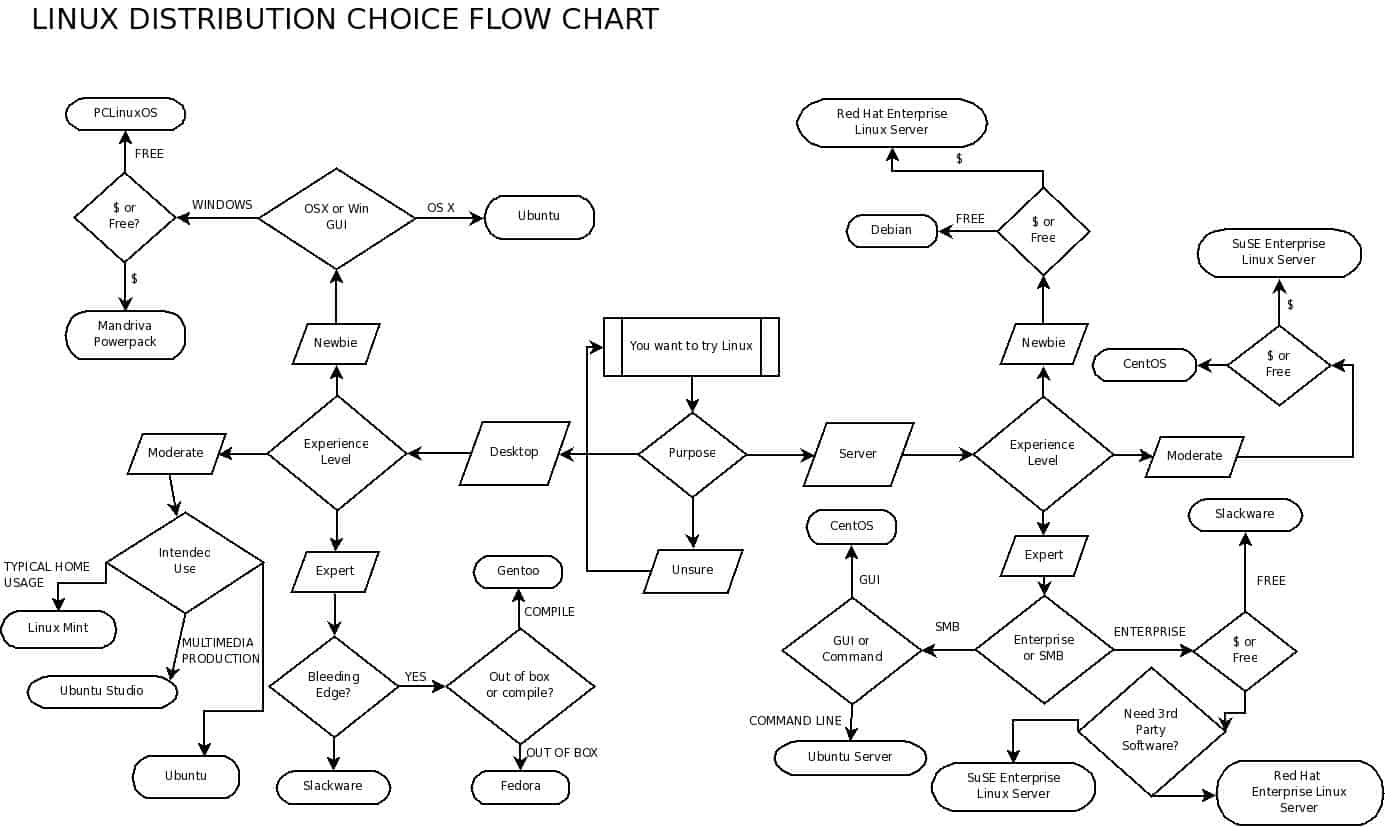
How to choose a Linux distribution flow chart

How to choose a Linux distribution flow chart: "

The new year is here and you have made a resolution to give Linux a try. A noble resolution and one that will be met, initially, with much confusion. Why? Linux isn’t like Windows where your choice is limited to a single release with different features (depending upon how much you want to spend) or OS X where you have no choice but to take what Apple gives you. No. Linux has a multitude of choices. In fact, if you go to Distrowatch you will see at least 100 distributions listed in the page hits ranking section. Think about it, 100 different versions of Linux. And that’s not all of them. There are many more variations out there, and more coming every day. And then, you add into the mix the enterprise level distributions that not only come with a price, but support, and the ever-staggering number continues to grow.


So how does a new-to-Linux user decide? With so many choices, how is it possible to start off on the right path? Without help, it’s not easy. My first Linux distribution was Caldera Open Linux 1. It was rough and nearly pushed me back to Windows. It wasn’t until I found Red Hat (4.2 at the time) that I found the right distribution for the right purpose. That was ten years ago and the choices were much more limited.


Because the new year is here, and I am always one to want to help people make the move to Linux, I thought I would create a flow chart to help Linux users make the right choice. Is it perfect? Probably not. Do I include every possible choice? No way. The distributions I have included are:


  • Ubuntu
  • Ubuntu Server
  • Ubuntu Studio
  • Slackware
  • Fedora
  • Red Hat Enterprise Linux Desktop
  • Red Hat Enterprise Linux Server
  • SuSE Enterprise Linux Server
  • SuSE Enterprise Linux
  • Gentoo
  • Mandriva Power Pack
  • CentOS
  • PCLinuxOS
  • Linux Mint
  • Debian

It’s still a healthy list of distributions, but not everyone. And I’m sure there will be those that disagree with my approach. That is understandable. So much so, that I am (in the spirit of open source) including my .dia file for the flowchart. NOTE: The .dia file is hosted on my domain (outside of ghacks). I would love to see how readers change my flowchart to better fit their opinions/experiences.


Figure 1


But for those that do not want to bother messing with editing the flowchart, and just want to see it in all its scattered “glory”, take a look at Figure 1.


One of the first things you might notice is the predestination paradox (temporal causality loop) I created for those unsure of their purpose for choosing Linux.


There might also be some initial confusion as to why I have included, in some choices, distributions that are rather similar. For example: The difference between Mandriva and PCLinuxOS might not be that great, but notice I have included the Mandriva Power Pack which includes pre-installed flash, various codecs, and Mandriva support.


Final thoughts


I hope this flowchart makes your choice of Linux an easier one. Even more, I hope this flow chart helps you to start your new year off on an open source foot, and that you find this path a rewarding one.

Friday, January 8, 2010

Cheers To Finger Power!

Cheers To Finger Power!: "

Mind you, this is not a “Green” concept and neither does it claim to be “Eco Friendly”. It’s just a helpful solution for a tricky situation. The situation being: you running out of juice on your mobile phone. So what do you do? Remove the battery from the back of the phone; give it a few good turns around your index finger and its gathered enough power to last you a conversation or a safe trip to your charger and electric point.


Designers: Song Teaho & Hyejin Lee


Swing Your Energy - Mobile Phone Battery Charger System by Song Teaho & Hyejin Lee


swing_your_energy2


swing_your_energy3

"